ALLEY CAT RESCUE
  • Home
    • About ACR >
      • Our Team
      • History
      • Board of Directors
      • Email Sign-up
      • Financial Information
    • ACR in the Press
    • ACR Publications
    • Adoptions >
      • Adoption Application
      • Advice for Adopters
    • Frequently Asked Questions
    • Contact Us
    • Partnerships
  • Action Alerts
    • The Feral Fix
    • Spay Neuter Pledge
    • No Declaw Pledge
  • Spay/Neuter
    • Early Age Spay/Neuter
    • Misconceptions About Spay/Neuter
    • State Low Cost Spay/Neuter
  • Community Cats
    • What is a Feral Cat? >
      • Feral vs. Stray Cats
      • Benefits of Feral Cats
    • Trap-Neuter-Return >
      • TNR Step-by-Step
      • TNR/Community Cat Care Resources
      • Introduce TNR to Your Shelter
      • Solutions to Common Complaints
      • TNR Statistics
    • CAT Action Teams: TNR Groups by State
    • Feral Kittens >
      • What to do if you find kittens
      • Orphaned Kittens
      • Fostering Kittens
    • Providing Shelter
    • Health Care
    • Cat Overpopulation
    • Relocation
    • How to Adopt Out Cats
    • Protecting Cats During Winter
    • Protecting Cats During Summer
    • Feral Cats and the Law
    • Cats and Wildlife >
      • Why Eradication Methods Fail
    • Handbook 2023 Ed
  • Cat Health
    • Health Care for Your Cat >
      • Vet Care Financial Assistance
    • Common Cat Health Issues >
      • FeLV and FIV
      • Feline Panleukopenia
      • FIP
      • Rabies
      • Zoonotic Diseases
      • Indoor/Outdoor Cats
    • Cats & Claws
    • Animal Cruelty Against Cats
    • Poisonous Hazards >
      • Poisonous Plants
    • Cats and COVID-19
    • Pet Food Banks
    • Pet Disaster Preparedness
  • Cat Behavior
    • Solutions to Prevent Surrendering your cat >
      • Rehoming
    • Introducing Cats
    • Tips for Entertaining an Indoor Cat
    • Lost Cat
  • African Wildcats
    • AWC Conservation Projects
    • Press Release on African Wildcat Campaign
    • AWC Photo Contest
  • Donate
  • Store

Advice for Adopters

Picture
New Cat Checklist
​​
So you’re planning on adopting a cat or kitten. CONGRATULATIONS!
​Before you bring your new family member home, there are few things to keep in mind:

​
1) New kitty will need a separate space all her own for the first few weeks to allow a smooth transition, especially if you have other animals in the house (scroll down for tips on introducing new cats into your home).
2) if you don’t already, you’ll need a veterinarian and
​3) you’ll need some supplies.  Below are items to make sure you have before you bring your new friend home.

  • Carrier: Anytime your cat has to leave the house, for a vet appointment, or other reasons, she should be secured in a carrier. By securing your cat in a carrier you are ensuring she is not able to run from you if they are frightened. This will help to keep them safe and calmer.​

  • Break-Away or Safety Collar With ID Tags: Please consider putting a safety collar and ID tag with your information on your cat. If the cat gets out, this collar will signal that the cat is an indoor pet who does not belong outside. If someone finds her, then they will be able to get in contact with you. This should help to ensure that your cat is not dropped off at a shelter. In addition, it’s highly recommended that you microchip your cat; collars can fall off.
 
  • Food and Water Bowls: Stainless steel or ceramic bowls can help to reduce cat acne (black itchy scabs) found on a cat’s chin. These should be cleaned often to prevent bacteria build up. 
 
  • High-quality Food (appropriate for the cat’s age): Your local pet store can help you to decide which food is best for your cat and your budget. You may choose to portion out your cat’s food or allow them to free feed; just make sure your cat is not overeating and gaining too much weight. You should have water available at all times. Consider buying a water fountain; cats prefer to drink from running water.
 
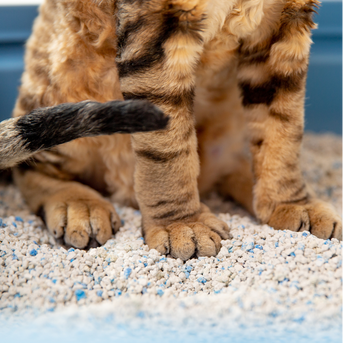
  • Litter Box, Litter, and Scoop: There are a wide variety of litter boxes and different types of litter available. Pick one that fits your household, and if you have more than one cat, you should be adding extra litter boxes. Scooping the litter box each day helps to keep the litter clean and will encourage your cat to continue to use the litter box. Many cats will not use a dirty litter box. Litter boxes should also receive a deep cleaning now and then. 
    • Product Suggestions
      • ​​Booda Dome Cleanstep Cat Box: A covered litter box with a filter that prevents accidental spill overs.
      • Nature’s Miracle Disposable Litter Box: If you need a disposable litter box, this eco-friendly option is cheap and tough on odor.
      • Omega Paw Self-Cleaning Litter Box: This manually self-cleaning litter box is cheaper than a fully automatic litter box and helps conserve litter and reduce odor.
      • PetSafe ScoopFree Ultra Self-Cleaning Cat Litter Box: If you’re in the market for a self-cleaning litter box that is fully automatic, this option comes with a hooded cover and self-cleans for weeks with no scooping, cleaning or refilling required. However, you do need to use their own crystal litter.
 
  • Scratching Posts: By providing your cat with a scratching post(s) this will encourage her to scratch on the designated post, rather than on carpet or furniture. There are several varieties of​ scratching posts available, you may need to try out a few different styles before finding one that your cat prefers. Cat trees are great for scratching too.
    • Product Suggestions​
      • Pioneer Pet SmartCat Ultimate Scratching Post: A good scratching post made with durable material that is tall enough for your cat to stretch while they scratch.
      • Sofa-Scratcher' Cat Scratching Post & Couch-Corner/Furniture Protector: If you’re looking to protect your couch, this scratching post covers the corners of your sofa and helps redirect undesirable furniture scratching.
      • Catit Play’n Scratch Cat Toy: This combination scratcher and toy will keep your kitten entertained as well as teach her good scratching habits while she’s still young. 
 
  • Grooming Essentials: Nail clippers and brushes are essential for any cat parent. Your veterinarian can teach you how to trim your cat’s nails and can work with you on recommending the best brush type for your cat’s coat. Keeping your cat’s nails short can make scratching less damaging. And although your cat does a good job of grooming on her own, brushing your cat can help to remove tangles and debris from her fur and prevent hairballs.
 
  • Bedding: Making a bed(s) available for your cat can give her a safe space to nap. She will likely chose to sleep elsewhere, but it is a good idea to give her a few options.
 
  • Toys: Cats can be very playful by nature. Providing them with a wide variety of toys provides them with exercise and entertainment. Playtime should be made an integral part of your cat’s routine to help manage weight and keep her active and healthy.
    • Product Suggestions​
      • FroliCat BOLT Interactive Laser Pet Toy: This toy is basically an automated laser pointer that randomly shoots the little red dot in various patterns on the floor.
      • Trixie 5-in-1 Cat Activity Center: This five in one toy will keep your cat entertained for hours.
      • Easyology Amazing Roller Cat Toy: Budget friendly and designed to keep your cat active and healthy. Good for cats of all ages.  
      • SmartyKat Catnip Cat Toys: Mice spiked with catnip that your cat will love.
  • Miscellaneous:
    • PetSafe SSScat: This motion sensor canned air will gently remind your cat to stop bad behavior, even when you’re not at home.
    • Thundershirt: If you have an anxious cat, the Thundershirt can help with triggering events, like trips to the vet or loud thunderstorms.
    • Pet Gear I-GO2 Traveler Roller Backpack: This adaptable carrier can go from a backpack to a roller bag to a duffle bag to a regular handle bag to a car seat. It comes in various sizes.
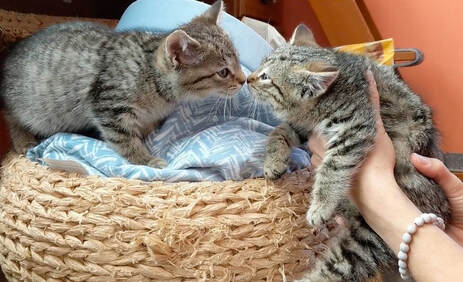
Introducing a New Cat Into the Home

Picture
A cat must be given time to adjust to her new surroundings, and to you. 

​​It will take several days for a cat to decompress. During this time, she will probably feel overwhelmed and may be scared. You won't see her true personality. She may not eat or drink and may spend all her time hiding under furniture. This is normal! However, it becomes dangerous if she does not eat and drink after three days. If that happens, you should try to entice her to eat with strong-smelling fish or treats and you may need to resort to force-feeding her wet food and giving her water with a dropper for a time.  

When you first bring your new kitty home, put her in a small room such as a bedroom or bathroom. Cats acclimate better in small spaces. Block off places she could go where you would be unable to reach her - underneath furniture, closets, etc. - but allow her some hiding spots you can access if necessary.

Once she seems comfortable in the small space, give her a larger space to roam if possible before letting her out through the whole home. Then when she seems confident and comfortable in this larger space, give her more area to explore. Continue the process of opening more and more space to her as she gets comfortable (again, as is possible given your particular living situation).

It will take about three weeks for her to settle in. As she gets comfortable over this period, she will explore her environment, get into a daily routine, and her personality will start to show. Behavior issues such as urinating outside the litterbox or becoming overstimulated when pet on certain parts of her body may appear and you can begin to correct them (see our solutions for common behavior problems for more information).

After about three months, she will be fully comfortable in her new home. She will begin to form a strong bond with family members. 

Introducing a New Cat to Other Pets

Picture
The most important thing to ensure when introducing new cats to one another is that all individuals are spayed or neutered and vaccinated prior to initial contact. You do not want to contribute to the cat overpopulation problem due to accidental pregnancies, nor do you want to transmit any disease, so please take all precautions.

It is also highly recommended that all cats are tested for disease (FeLV/FIV) prior to making any new introductions. And cats should be treated for internal (worms) and external (fleas) parasites to prevent transmission. Make sure there are no visible signs of illness in either cat, such as an eye infection or upper respiratory infection, prior to making introductions; it is much easier to treat one cat than having to treat two or more cats for an illness.

Take it SLOWLY when introducing new animals to one another.
 
Step One
The best way to introduce a new cat to another cat (or dog) is to confine the new cat to a single room for a few weeks; this is also recommended even if the new cat is the only animal in the house. This will allow her some time to adjust to her new environment without any intimidation from her housemates, while also providing her a place where she can feel safe. If you do have another cat, you can switch their cat beds so they grow used to one another’s scents, animal rights writer Nomi Berger suggests.

The new cat can make her initial acquaintance with a protective barrier (closed door) in place, where they can begin to smell and communicate with each other under the door.

Get the cats acclimated to each other's scents by allowing them sniff each other under a closed door (scent-swapping).
---
Step Two 
Allow them to see each other by propping the door open just wide enough for visual contact (but make sure neither cat can squeeze through!). This should be repeated frequently over the course of several days, before moving on to the next stage of acclimation.

​---
Step Three
When making first nose-to-nose introductions, it is highly recommended that you also use a large crate or playpen to help facilitate safely. Initially, the animals should show interest in wanting to smell each other and they may even reach through the bars to bat at each other. Hissing, growling, and some swatting is to be expected.

Promote good behavior and help keep the cats calm by offering treats (meaty baby food, without onion, fed on a spoon or your fingertip is a particularly tasty snack), petting them, and using a soothing voice to praise. Use a wand toy to coax them to play together through the bars. Be consistent in training them on what actions are viewed as acceptable and which are not. Always supervise and only allow one additional animal in the room with her at a time.

Picture
---
Step Four
​
After a week or two of getting acquainted through a barrier, you can slowly allow more intimate interactions. It is advised to have a spray bottle of water on hand to correct any bad behavior and to safely break up any fighting. It may take some time for the cats to work out their hierarchy of who is “top cat.” Sit on the floor in front of the cage and gently coax the new cat out into the room, while keeping an attentive eye on your other cat.
 
At this stage, they should be fairly familiar with each other and engage in a nose-to-nose greeting. As they continue to thoroughly smell each other, some hissing and swatting may occur. Be prepared to correct any behavior before it escalates into fighting. A few squirts from a water bottle should defuse any fighting or you can make a loud noise, such as clapping your hands, to startle them. Never use your hands to break up a cat fight; this is very dangerous and could result in injury.

Allow the cats to interact with each other for short periods of time, building up to longer visits. Use your best judgment to gauge each cat’s ability to tolerate the other in deciding how long each visit should last. 
 
Utilizing products such as sprays and plug-in diffusers that simulate natural cat hormones, can help alleviate stress and tension and aid in relaxation. You may consider using lavender scented candles or oils in the room or adding a few drops of a calming agent to the cat’s water. Always read the labels before using any products and provide supervision during initial use to make sure your cat(s) do not have any allergic reactions.
 
Toys can be a great way to facilitate interaction between cats, while relieving stress. Most cats can be easily coaxed into playing with one another, because it creates a distraction that is positive. When both cats are enjoying themselves and having fun, they are less likely to be bothered by the other’s presence. Wand toys and laser pointers are especially helpful in directing joint play sessions, as well as the circular cardboard scratchers that have a track for a ball; get the ball spinning and watch as the cats dart after it! Use treats, catnip, and praise to reinforce positive behavior.  ​

Picture
---
Step Five
​
Once she has made introductions with her other housemates and they seem to get along for the most part (some initial minor fighting is to be expected until everyone has reached an understanding), you can slowly introduce her to the rest of the house. Allow her to explore the remaining rooms for short periods of time, while supervised of course, and confine her back to her room so she can feel safe. It is helpful to keep bedrooms and other spare rooms closed to help minimize the amount of new space she has to explore and the amount of hiding places available. At first, you might also want to confine your other companion animals to allow the new cat to explore; this can be a delicate balance, so use your best judgment of the situation. Continue with periods of exploration and periods of confinement until you and her feel comfortable with her having free-range of the entire house.
 
Remember, each cat is different. Some will take to their new family members and living situation with ease, while others may need more time and patience to adjust. Take your time during this transition period and try not to rush or force the new cat; allow her to take as much time as she needs to feel comfortable. If you’re not sensitive to her needs, you could cause undue stress which will make her frightened, reserved, and more likely to hide. So be PATIENT and your new member of the family will find the trust and confidence she needs to be curled up on the couch next to you.

References: 
-Knierim, Ashley. “The 9 Best Cat Toys of 2019.” The Spruce Pets, The Spruce Pets, 4 Apr. 2019, www.thesprucepets.com/best-cat-toys-4153336.
-Murphy, Shayna. “5 Great Litter Boxes That Actually Keep Odors Under Control.” Bustle, Bustle, 12 June 2019, www.bustle.com/p/the-5-best-cat-litter-boxes-for-odor-control-10073457.
-Naidus, Alex. “19 Products Your Cat Needs, Other Than A Cardboard Box.” BuzzFeed, BuzzFeed, 18 Aug. 2016, www.buzzfeed.com/alexnaidus/incredible-products-every-cat-owner-needs-like-yesterday.
Proudly powered by Weebly
  • Home
    • About ACR >
      • Our Team
      • History
      • Board of Directors
      • Email Sign-up
      • Financial Information
    • ACR in the Press
    • ACR Publications
    • Adoptions >
      • Adoption Application
      • Advice for Adopters
    • Frequently Asked Questions
    • Contact Us
    • Partnerships
  • Action Alerts
    • The Feral Fix
    • Spay Neuter Pledge
    • No Declaw Pledge
  • Spay/Neuter
    • Early Age Spay/Neuter
    • Misconceptions About Spay/Neuter
    • State Low Cost Spay/Neuter
  • Community Cats
    • What is a Feral Cat? >
      • Feral vs. Stray Cats
      • Benefits of Feral Cats
    • Trap-Neuter-Return >
      • TNR Step-by-Step
      • TNR/Community Cat Care Resources
      • Introduce TNR to Your Shelter
      • Solutions to Common Complaints
      • TNR Statistics
    • CAT Action Teams: TNR Groups by State
    • Feral Kittens >
      • What to do if you find kittens
      • Orphaned Kittens
      • Fostering Kittens
    • Providing Shelter
    • Health Care
    • Cat Overpopulation
    • Relocation
    • How to Adopt Out Cats
    • Protecting Cats During Winter
    • Protecting Cats During Summer
    • Feral Cats and the Law
    • Cats and Wildlife >
      • Why Eradication Methods Fail
    • Handbook 2023 Ed
  • Cat Health
    • Health Care for Your Cat >
      • Vet Care Financial Assistance
    • Common Cat Health Issues >
      • FeLV and FIV
      • Feline Panleukopenia
      • FIP
      • Rabies
      • Zoonotic Diseases
      • Indoor/Outdoor Cats
    • Cats & Claws
    • Animal Cruelty Against Cats
    • Poisonous Hazards >
      • Poisonous Plants
    • Cats and COVID-19
    • Pet Food Banks
    • Pet Disaster Preparedness
  • Cat Behavior
    • Solutions to Prevent Surrendering your cat >
      • Rehoming
    • Introducing Cats
    • Tips for Entertaining an Indoor Cat
    • Lost Cat
  • African Wildcats
    • AWC Conservation Projects
    • Press Release on African Wildcat Campaign
    • AWC Photo Contest
  • Donate
  • Store